Death Tarot Card Meaning

Death marks an ending that changes the available future. The card usually concerns a role, pattern, relationship form, or identity that cannot continue unchanged, not literal death.

Death is irreversible change brought into the open. The card does not celebrate loss; it insists that renewal becomes possible only after the obsolete form is allowed to end.

  • ending
  • transition
  • release
  • transformation
  • closure
  • change
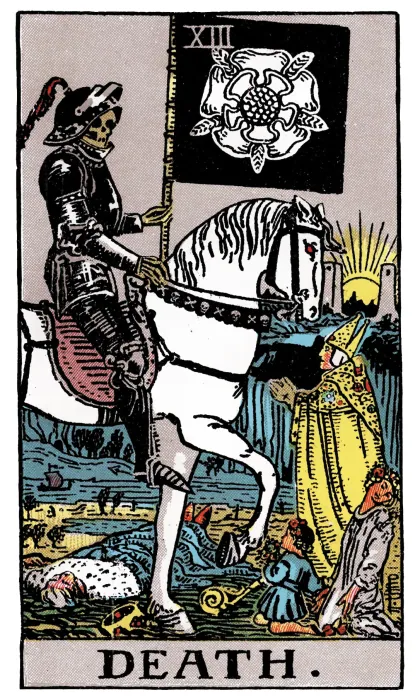
Death tarot card from a Rider-Waite-Smith-style deck
Death · Major Arcana 13 Artwork by Pamela Colman Smith (1909) · Public Domain Mark 1.0
Arcana
Major
Number
13
Upright
No
Reversed
No

Death upright and reversed meaning

Direct expression

Upright

Death marks an ending that changes the available future. The card usually concerns a role, pattern, relationship form, or identity that cannot continue unchanged, not literal death.

Upright, Death appears when continuation would require pretending that the central condition has not changed. An ending may be chosen or imposed, welcome or painful, but it creates a boundary between what can still be repaired and what must be released.

The card supports deliberate transition: communicate closure, settle obligations, preserve knowledge, and make room for grief. New beginnings are not a requirement to feel positive immediately. They become credible after the ending is acknowledged.

Practical adviceName what is over, complete the necessary closure, and decide consciously what should be carried forward.
Blocked or redirected

Reversed

Death reversed shows resistance to an ending or a transition left incomplete. The old form may be gone in practice while habits, obligations, or hope keep it occupying the future.

Reversed, the person may understand intellectually that something is over while daily behavior continues to organize around its return. The gap can prolong uncertainty and prevent resources from reaching the next phase.

It can also show a transition blocked by unfinished practical work. Contracts, belongings, explanations, or rituals of closure may need attention. Acceptance is not only an emotion; it can be expressed through completed actions.

Practical adviceStop negotiating with the fact of the ending and put energy into the transition work that remains.

Symbols in Death

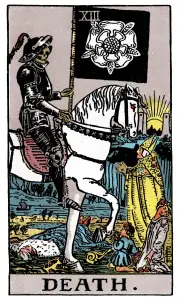
In the Rider-Waite-Smith card, an armored skeleton rides a white horse and carries a black banner bearing a white rose. A fallen crowned figure lies beneath the horse, while a child, a woman, and a religious figure face the rider differently. A river and small boat cross the background. Between two towers, a sun appears at the horizon. The image places every social position before the same transition while keeping continuity visible beyond the immediate loss.

The armored skeleton
The rider strips identity down to what continues beyond status and presents change as impartial.
The black banner and white rose
The contrasting emblem holds loss and purification in the same visible sign.
The figures before the horse
Different responses across age and rank show that transition meets people without respecting social position.
The river, boat, and rising sun
Movement and light in the distance preserve continuity beyond the immediate ending.

Love, career, money, feelings, and yes-or-no meanings

Love & relationships

Love · upright

In love, Death may indicate the end of a relationship, but often it names the end of how the relationship has been operating. A pattern, expectation, or former version of the bond may need to be grieved and released. Renewal is possible only if both people stop asking the old arrangement to return under a new label.

Reversed

In a relationship, an expired pattern may continue because ending it feels more frightening than repeating it. This can include refusing closure after separation or trying to restore a version of someone that no longer exists. Grief needs room, but contact and hope should not be used to prevent reality from becoming clear.

Try a three-card love tarot reading

Work & direction

Career · upright

At work, this card can accompany leaving a role, closing a project, retiring a strategy, or accepting that a professional identity no longer fits. Preserve what was learned, communicate the transition clearly, and stop funding the part that has already ended. A clean closure protects more value than prolonged denial.

Reversed

At work, a legacy process, role, or product may be consuming resources after its purpose has ended. Fear of wasted effort can make the delay more expensive. Define the decommissioning work, protect people affected by the change, and separate honoring past value from requiring permanent continuation.

Draw one card for practical guidance

Emotional perspective

As feelings · upright

Death suggests that someone's emotional relationship to the connection is changing fundamentally. They may be grieving, detaching, or unable to continue under the former terms. The card does not specify whether a different bond will follow.

Reversed

They may cling to a past version of the relationship, resist closure, or fear the identity change that an ending would bring. Attachment can remain strong even when the previous form is no longer workable.

Resources & exchange

Money · upright

For money, Death can mark the end of an income source, debt cycle, business model, or spending pattern. Close accounts and obligations carefully, protect necessary reserves, and treat the transition as a plan rather than a vague hope.

Reversed

Reversed, money may keep flowing to an obsolete commitment because stopping would acknowledge a loss. Review cancellation costs, sunk costs, and transition support. Delay should have a defined benefit, not merely postpone recognition.

Directional shorthand

Yes or No Direction

UprightNo

Usually no to continuing in the current form; the card supports closure, release, or a materially different arrangement.

ReversedNo

No while resistance to an ending or unfinished transition work keeps the situation tied to a form that no longer functions.

“What do I need to accept about a chapter that is ending?”

Interpretation

The old arrangement has likely reached its limit. Grieve what mattered, stop negotiating with the part that is over, and decide what should be carried into the next phase.

Death in a past, present, future spread

01

Past

A significant ending or transformation removed an earlier structure.

02

Present

A transition must be acknowledged before renewal can begin.

03

Future

A cleaner new phase becomes possible after the obsolete pattern is released.

Want to see these positions with cards of your own? Try a Past–Present–Future tarot reading.