Justice Tarot Card Meaning

Justice asks whether a choice can withstand scrutiny. Facts matter, but so do the rule being used, the interests it serves, and the consequence that follows.

Justice joins deliberation with consequence. The scales ask what deserves weight; the raised sword asks whether the resulting decision can be stated clearly and owned.

  • fairness
  • truth
  • accountability
  • cause and effect
  • law
  • clear decisions
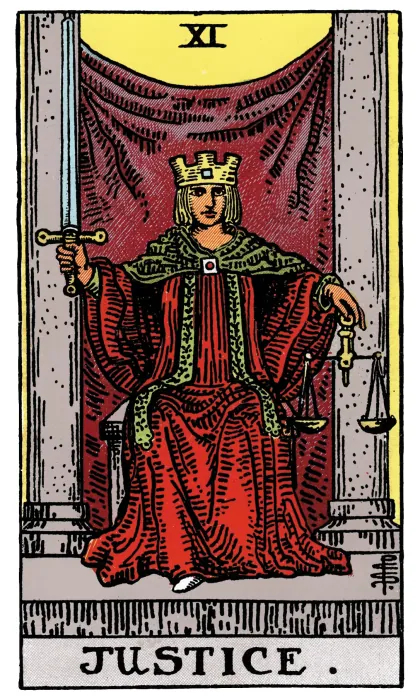
Justice tarot card from a Rider-Waite-Smith-style deck
Justice · Major Arcana 11 Artwork by Pamela Colman Smith (1909) · Public Domain Mark 1.0
Arcana
Major
Number
11
Upright
Yes
Reversed
No

Justice upright and reversed meaning

Direct expression

Upright

Justice asks whether a choice can withstand scrutiny. Facts matter, but so do the rule being used, the interests it serves, and the consequence that follows.

Upright, Justice asks for a decision that can be explained without changing the standard halfway through. Relevant facts, prior agreements, and foreseeable consequences all belong in the assessment. The card is especially useful when personal preference is quietly being presented as a neutral rule.

Accountability here is not limited to blame. It can mean correcting an error, honoring a contract, acknowledging the benefit one received, or accepting an outcome produced by a fair process. The aim is a proportionate response, not punishment for its own sake.

Practical adviceName the rule before choosing the winner, then check that it does not change for convenience.
Blocked or redirected

Reversed

Unequal rules, missing context, or avoided responsibility may be distorting the outcome. Correction begins with the part of the process that cannot be defended consistently.

Reversed, Justice points to a distorted record or a standard applied unevenly. Information may be withheld, one party may control how the issue is framed, or the official process may look orderly while excluding the context that would change the result.

The reversal can also mark self-justification. A person may know where responsibility lies but keep refining the explanation to avoid the consequence. Repair begins by naming the exact omission, double standard, or action that needs to be corrected.

Practical adviceFind where the process bends for one side and repair that point before accepting the verdict.

Symbols in Justice

The Rider-Waite-Smith Justice sits frontally between two gray pillars, with a purple veil closing the space behind the throne. The figure wears a red robe, holds level scales in the left hand, and raises a straight double-edged sword in the right. A square ornament sits at the center of the crown, and one white shoe shows beneath the robe. The symmetry and direct gaze make the scene formal, but the separate tools remind the viewer that weighing and deciding are not the same act.

The scales in the left hand
The level pans place comparison before action and suggest that each claim should be given proportionate weight.
The upright double-edged sword
The sword is held ready and vertical. It suggests a decision that can cut in more than one direction and carries consequences once applied.
The two stone pillars
The seated figure is framed by a formal structure, reinforcing that judgment depends on a stated standard rather than a passing preference.
The red veil
The cloth closes the background and gives the seated figure a contained, formal setting, keeping attention on what is being weighed.
The square crown ornament and frontal posture
The geometric ornament and still pose emphasize order, deliberation, and accountability for the ruling.

Love, career, money, feelings, and yes-or-no meanings

Love & relationships

Love · upright

A relationship question turns on honest accounts, explicit agreements, and whether actions match what was promised. This can support a clarifying conversation, a fair division of responsibility, or a decision made without punishing one person for naming an uncomfortable fact. Harmony is not the only measure of fairness; both people need room to speak and the same expectations must apply to each.

Reversed

Selective memory, double standards, or avoided accountability may be protecting short-term comfort. One person may demand transparency while withholding it, or frame every disagreement as a trial with a predetermined verdict. Before deciding who is right, identify the shared agreement, the missing context, and any expectation that only one person is required to meet.

Try a three-card love tarot reading

Work & direction

Career · upright

Contracts, evaluation criteria, documentation, and ownership deserve close attention. Justice can describe a formal review, negotiation, compliance issue, or decision that must be explained to others. A credible process states the criteria before the outcome is known, records relevant exceptions, and gives the affected people a reasonable way to understand or challenge the result.

Reversed

A review, contract, investigation, or allocation may be biased, incomplete, or poorly documented. There may also be a personal error that is easier to defend than correct. Preserve the record, separate a disappointing result from an unfair process, and challenge the exact criterion or omission that cannot be applied consistently.

Draw one card for practical guidance

Emotional perspective

As feelings · upright

Justice is measured rather than effusive. Someone may be evaluating whether trust, effort, and expectations are genuinely mutual, or deciding what responsibility they are prepared to accept. The interest can be sincere, but it wants clarity and conduct that matches the stated agreement.

Reversed

They may include resentment, defensiveness, guilt, or a sense of being judged by rules that were never mutually agreed. A person could be keeping an internal scorecard or revising the past to protect their position. Direct questions are more useful than trying to infer a verdict from distance.

Resources & exchange

Money · upright

For money, Justice favors accurate records, transparent terms, proportionate pricing, and obligations that can be met as written. It can point to contracts, taxes, settlements, reimbursements, or a financial decision where the method matters as much as the amount. Review the document rather than relying on a summary.

Reversed

Reversed, fees, ownership, reporting, or distribution may be unclear or unequal. The problem could be misconduct, but it could also be a preventable record error or misunderstood clause. Reconcile the numbers, preserve evidence, and obtain qualified advice when the legal or tax stakes are material.

Directional shorthand

Yes or No Direction

UprightYes

Usually yes when the relevant facts are available, the agreement is clear, and every option is being judged by the same standard.

ReversedNo

No for now when a missing record, unequal rule, undisclosed interest, or avoided responsibility makes the proposed outcome unreliable.

“How should I decide when both sides have a reasonable argument?”

Interpretation

Define the criterion before comparing the two sides. Then separate verified information, personal stakes, and exceptions; a choice becomes more defensible when none is hidden inside the reasoning.

Justice in a past, present, future spread

01

Past

A contract, ruling, unequal exchange, or unaddressed consequence established the present conditions.

02

Present

Responsibility cannot be assessed fairly while the rule changes to protect a preferred result.

03

Future

A more defensible outcome becomes possible when records are complete, criteria stay consistent, and someone owns the consequence.

Want to see these positions with cards of your own? Try a Past–Present–Future tarot reading.