The Hierophant Tarot Card Meaning

The Hierophant points to knowledge, ritual, or standards transmitted through a group. The useful question is not whether tradition is automatically right, but what it preserves and how consent operates inside it.

The Hierophant is collective knowledge given form. His card examines the promise and cost of learning, belonging, and committing within a system that existed before the individual.

  • tradition
  • teaching
  • institutions
  • commitment
  • shared values
  • conformity
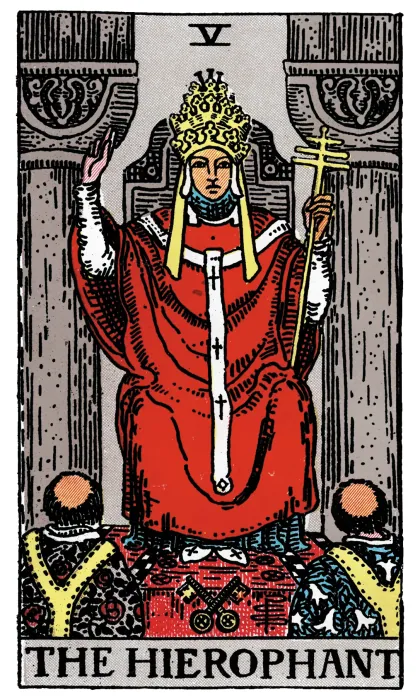
The Hierophant tarot card from a Rider-Waite-Smith-style deck
The Hierophant · Major Arcana 5 Artwork by Pamela Colman Smith (1909) · Public Domain Mark 1.0
Arcana
Major
Number
5
Upright
Yes
Reversed
Maybe

The Hierophant upright and reversed meaning

Direct expression

Upright

The Hierophant points to knowledge, ritual, or standards transmitted through a group. The useful question is not whether tradition is automatically right, but what it preserves and how consent operates inside it.

Upright, The Hierophant can show the value of a tested framework. A shared vocabulary, mentor, ceremony, or professional standard may help people coordinate and preserve lessons that would be costly to rediscover alone. Belonging can make commitment visible and support follow-through.

The card also asks how authority is earned. A teacher should be able to explain the method, acknowledge limits, and allow the learner to develop judgment. Tradition remains useful when it carries purpose rather than demanding obedience to its surface.

Practical adviceIdentify the tradition or standard in play, learn its purpose, and decide consciously which part deserves your commitment.
Blocked or redirected

Reversed

The Hierophant reversed questions a rule that has become detached from its purpose. Independent thought may be necessary, but rejecting every shared standard can create a different kind of rigidity.

Reversed, an institution may protect its own continuity more strongly than the value it claims to serve. Rules can become ceremonial obstacles, dissent may be mislabeled as ignorance, or access to knowledge may be controlled to preserve status.

Personal rebellion can become equally automatic. Rejecting a convention without understanding its function may remove safeguards along with constraints. A responsible alternative states what will replace the old method and how its results will be assessed.

Practical adviceQuestion the rule by naming the value it should serve and showing where current practice fails that value.

Symbols in The Hierophant

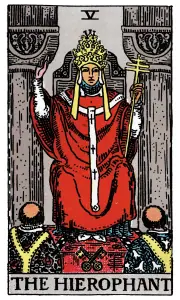
In the Rider-Waite-Smith card, a religious figure sits between two gray pillars and raises the right hand in blessing. A triple crown and a three-tiered staff emphasize office rather than private identity. Two followers kneel before him in differently patterned robes, and crossed keys lie at their feet. The red, white, and blue garments, repeated threes, and formal architecture make the scene about transmission, rank, and participation in an established order.

The triple crown and staff
Repeated tiers emphasize formal office, accumulated authority, and teaching carried through an institution.
The raised hand
The blessing gesture makes sanctioned knowledge and the power to recognize belonging visible.
The two kneeling followers
Their different robes show distinct participants receiving instruction inside the same shared structure.
The crossed keys
The keys suggest access, interpretation, and the institutional power to open or restrict a threshold.

Love, career, money, feelings, and yes-or-no meanings

Love & relationships

Love · upright

In love, this card can support formal commitment, shared beliefs, counseling, or a relationship made legible to family and community. It may also raise practical questions about marriage, religion, culture, or the rules each person inherited. Agreement is meaningful when both people choose it, not when conformity is treated as proof of devotion.

Reversed

In relationships, family, religious, or social expectations may be crowding out the agreement the two people would choose for themselves. The reversal can also describe resistance to commitment simply because it looks conventional. Separate the form from the value: decide what loyalty, exclusivity, or partnership actually means to the people involved.

Try a three-card love tarot reading

Work & direction

Career · upright

At work, The Hierophant favors mentorship, training, certification, and established procedures that reduce avoidable mistakes. A respected institution or experienced teacher may help. Learn why the method exists before discarding it, but keep evidence and current conditions in view; seniority alone does not make guidance correct.

Reversed

At work, bureaucracy, outdated training, gatekeeping, or an unhelpful expert consensus may be slowing a better method. A challenge is stronger when it understands the current rule and provides evidence for an alternative. Avoid making novelty the only credential; document why the change is safer, clearer, or more effective.

Draw one card for practical guidance

Emotional perspective

As feelings · upright

The Hierophant suggests seriousness shaped by values, duty, or a wish for recognized commitment. Someone may be considering how the connection fits their family, faith, or long-term definition of partnership. Their intentions become clearer when they can discuss those expectations directly.

Reversed

They may resist labels, conventional milestones, or an agreement imposed from outside. A person could value the bond but reject the expected form, or avoid commitment while calling every request for clarity restrictive. Ask what arrangement they are actually willing to maintain.

Resources & exchange

Money · upright

For money, The Hierophant favors established institutions, qualified advice, documented procedures, and conservative choices whose rules are understood. It may relate to education costs, pensions, regulated products, or organizational funding. Verify the advisor's role and incentives.

Reversed

Reversed, fees, gatekeeping, or outdated conventional advice may not fit the actual situation. Unregulated alternatives can also carry risks hidden behind anti-establishment language. Compare terms and credentials rather than choosing solely for or against institutional authority.

Directional shorthand

Yes or No Direction

UprightYes

Usually yes when the choice aligns with consciously shared values and a tested structure offers useful guidance or protection.

ReversedMaybe

Maybe when the current rule does not fit, but a responsible alternative and an honest agreement have not yet been established.

“Should I follow the established route or create my own approach?”

Interpretation

Learn the existing method well enough to understand what it protects. Then decide deliberately which parts deserve respect and which parts need revision.

The Hierophant in a past, present, future spread

01

Past

Education, family values, or an institution supplied the original framework.

02

Present

A mentor, standard, or shared commitment may provide useful orientation.

03

Future

Formalizing a commitment can help, provided the rules remain aligned with lived values.

Want to see these positions with cards of your own? Try a Past–Present–Future tarot reading.